Monday, 11 March 2013
Sunday, 10 March 2013
Marmara
While doing my usual Sunday afternoon camp out at Marmara today I decided to swap out reading El Pais for a book that Professor Vamvakas sent me in the mail mid-January. I've becoming something of a piece of furniture at Marmara for the following reasons
- it's the halfway point between my apartment and school
- their tapas are cheap and so rich
- coffee is also cheap
- the atmosphere its very chill, and I don't feel weird spending hours at a time there
- I'm slowly but surely establishing relationships with the employees
There's a guy that is always behind the counter there. Honest, he must have a bed in the basement because I swear he never leaves. My first impression of him was that he was intimidating and really didn't appreciate my goofiness/indecisiveness as I peruse the tapas nearly every day. But, as time has past, I think he's warmed up to me-- we're familiar now.
I was taken aback today because as I was reading my book he came and stood next to my table and stared at the page. Upon realizing it was in english, he made a face and shook his head saying "You should read spanish books". I took this as my chance to form a bond and asked him to give me some recommendations. Below is a list he wrote out for me... and excited as I am to check them out, it's more exciting knowing that we could now be pals.
The second picture happens to be a note written from another waiter at Marmara. Upon seeing the first guy give me the list of books, he asked me if he too could add something to the list. I gave him the note, excited to see what he would write. He came back with part of the note covered and said, the name of the book is called "Para salir de Fiesta"... which translates roughly, "if you want to party".... and then he uncovered the bottom half revealing his own phone number. I laughed and laughed so awkwardly and definitely turned bright bright red. So yeah, successful day bonding with the Marmara bunch
Saturday, 9 March 2013
Week Six
Well here I am after just finishing week number six in Spain. Looking at a calendar I can gaze at the weeks past but the true evidence of my time here is much more objective. My hair has grown longer, my body has changed after a bout with tonsillitis and completely new eating habits. Sleeping occurs from the wee hours of the morning until mid morning almost each day and meeting with friends doesn't happen until at least eleven each night. Time has shown itself in the form of my relationships, which have grown strong and comforting. The awkwardness of being new in a city has subsided and now this place feels like a new version of home. Walking into my favorite cafes and being recognized by the men and women behind the counter, knowing which places to go on which nights, establishing relationships with the Spanish students- these are the little things that all put together create a feeling of such peace.
Sat by the river today thinking about how accelerated and profound all of these changes feel. When every day presents you with something that expands your mind or challenges your spirit its easy to lose track of what you once were. Being away from everyone and everything you know gives you the chance to strip down to your own bottom lines. There aren't external influences that have you act or think a certain way. Obstacles that I have built for myself and behavior that I have frequently defaulted to can be thrown away because here I am whoever I want to be. An open, more expressive, and more honest version of myself is emerging.
Sunday, 3 March 2013
Saturday, 2 March 2013
Caminito Tango
Irine brought us to see Lisa Anderson perform last night at a bar in the northern part of the city. Unfortunately I couldn't get any great clips of her singing in French, but here's a little bit of the show...
Tuesday, 26 February 2013
23-F
After Franco's death in 1975 the Spanish state worked diligently to piece together the remnants of the Second Republic and reestablish democracy. The consolidation of democracy in Spain was being challenged by an economic crisis ( 20% unemployment, 16% inflation) and major unrest within the autonomous regions of Pais Vasco y Cataluna.
These socio-economic problems coupled with a military conditioned to Franco-style strength paved the way for what is now known as 23-F.
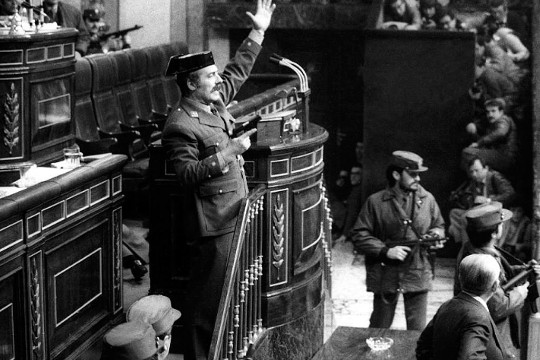
On the 23rd of February in 1981, Colonel Antonio Tejero and 200 soldiers from la Guardia Civil burst into Congress armed and ready to overtake the government. They held the congress hostage for 18 hours but ultimately failed to take over the state. The importance of this was that it demonstrated the Spanish will to maintain democracy and suggested that these ideals had been internalized.
| General Tejero speaking to Congress while holding them at gunpoint |
So I had never heard of this event before, and was really intrigued by the entire history of the failed coup. Upon returning home for lunch I mentioned the date to my host mother and she immediately perked up. Turns out, her first cousin was with Tejero that day that they stormed the congress. He had been ordered to Madrid days before and ultimately ended up being there to assist the overtake.
She continued by saying that after the coup her cousin spent two years in a prison and now everyone in the family calls him "golpista".
Living history. Mind is blown.
Monday, 25 February 2013
Sunday, 24 February 2013
Domingo Perezoso
All set up at Marmara cafe with my coffee, brownie, and pile of reading. This evening I have two intercambios set up...nervous but excited to meet girls my age. Fingers crossed they're down to be our friends!
Last night we went to La Sureña where you can get buckets of beer for €3. The atmosphere there is really fun, lots of young people at big tables playing cards and singing...it's a nice spot to start out the night.
It wasn't long after we left Sureña that we met up with the gang of Spanish students at Bender. Another awesome night of hanging out with them and using sooo much Spanish. Perhaps the most pleasant surprise was being serenaded by three of the guys who wanted to show off how well they can sing Maroon 5' s "She Will be Loved". It was the most shocking and wonderful thing to see. We followed it up with an encore of Rocket Man...because apparently they're big Elton John fans...
Starting to learn some of the tunes that are frequently played in the bars... Hopeful that soon I won't have to just make up the words to the songs. This is what I woke up singing:
http://youtu.be/80CBtRbudvk.
Adios for now!
Last night we went to La Sureña where you can get buckets of beer for €3. The atmosphere there is really fun, lots of young people at big tables playing cards and singing...it's a nice spot to start out the night.
It wasn't long after we left Sureña that we met up with the gang of Spanish students at Bender. Another awesome night of hanging out with them and using sooo much Spanish. Perhaps the most pleasant surprise was being serenaded by three of the guys who wanted to show off how well they can sing Maroon 5' s "She Will be Loved". It was the most shocking and wonderful thing to see. We followed it up with an encore of Rocket Man...because apparently they're big Elton John fans...
Starting to learn some of the tunes that are frequently played in the bars... Hopeful that soon I won't have to just make up the words to the songs. This is what I woke up singing:
http://youtu.be/80CBtRbudvk.
Adios for now!
Sunday, 17 February 2013
El Huerto de Calixto y Melibea
| entrance to the garden |
![]() |
| Love letter written on the wall of the garden |
![]() |
| And another one |
Stumbled upon a random elevated garden yesterday while walking around the city with Maddy. Possibly my favorite find yet, it is filled with lattice archways, cast iron decor, and the most beautiful vegetation.
In the center of the garden is a cast iron arch filled with "candados" or padlocks. The way this works is that a pair of lovers (or maybe friends) buys a lock, writes their initials on it, and locks it to the arch. The tradition exists because this garden is said to be the setting for some of the most important scenes in La Celestina, a famous Spanish novel.
Ser mas Suave
Last night was easily the best I've had since getting here. Around 11:00 I met up with Maddy, Erika, and Lo debajo del reloj and we began searching around for a place to get some tapas/beer. The funny and helpful thing about being in the Plaza at that time of night is that it's crawling with promoters. We are constantly being handed promotions and drink coupons and the more aggressive promoters actually attempt to shuffle you toward their bar/club. The positive of all of this is that it forces the pricing to be super competitive which often times means that we don't have to pay much at all (or anything) to get drinks.
Just to give an idea, here's a snapshot of bars in the neighborhood we were hanging around--- every red dot is a bar or club, and not all of them are even listed on google.
We ran into Will and Andy on our quest to find a low-key place to hang out and they decided to come along. Finally we ended up at a place Lo and her friends went all the time last semester... The Holy Cross. It's just your typical Irish pub... which seems to be quite a thing here in Salamanca. I don't know what it is about Irish pubs that draws so many people in, but it was absolutely packed. We sat around a table made of whiskey barrels and shared some beers and laughs.
After Holy Cross we wandered over to our usual spot, El Savor. This is a salsa club that always has live music. Upon entry we were sad to discover that our friends weren't there and decided it was a little too early in the night to start shamelessly trying to salsa. So we moved on.
Next we went decided to pick up the pace a little bit and went to Gatsby. Gatbsy is just your average dance club that generally has great specials when it comes to drinks. We wandered over and did some tequila and dancing before deciding it was time to head to the next place.
At this point we were straight up meandering around trying to decide where we could find some of our friends. We trekked over to a place called Submarino which is a club quite literally decorated as the inside of a submarine. The freaky thing about this place is that it kind of smells like chlorine.. it's unsettling. We looked around, couldn't find the gang, and headed out.
After meandering for a few minutes we ran into two more kids from our program. We asked if they had seen the others and it just so happened they were in the bar we were standing in front of. Excitedly ran into the bar whose name I am completely unsure of, and were greeted by Miguel and a ton of Erika's friends from the residencia who are spanish.
We were introduced to all of them and they are all so friendly. We decided to solidify our new friendship with shots and dancing and it all fell in to place rather naturally. Minutes after meeting them we were dancing in a circle and embracing.
The rest of the night sort of followed suite. We went outside the bar and lingered in the street with all of these new friends who were hellbent on teaching us swears and phrases we needed to know. One student was very persistent in having me teach him how to hit on girls in English and so we both learned some new tricks.
After a while of standing in the street and having such so much spanish conversation, three of the sweetest students sort of adopted Erika, Maddy, and I and made it their goal to show us around town for a bit. Upon entering the first place with this group, Guaydil (our new pal) turned to me and said that this was going to be a funny surprise. Basically, he was totally fucking with us and brought us into a hardcore metal bar. Now, I have never been to a Metallica or Korn concert but if I had to imagine what it would be like, I would imagine everything that I experienced at this bar. Piercings, crazy haircuts, leather, studs, moshing, you name it. It was all very terrifying and hysterical. Needless to say we were only there long enough for Maddy and I to cram into the bathroom together (which was lacking a toilet seat and had a sink half ripped out of the wall) for a break.
After this place we went back to El Savor and this time it was really packed. The band was making sweet salsa music as we sheepishly went towards the dance floor. I have never been confident in my dance moves but this was a whole new level of embarrassment. Guaydil and his two friends did their best to teach us the ways. Maddy got swept up by a random older man and was being swung all around the dance floor while Guaydil made me his dance partner. I was unbelievably intimidated by how great of a dancer he is and so as he encouraged me to "se mas suave" (be more smooth) to which I replied "salsa no está en mi sangre como si" (salsa is not in my blood like you)
Shame or not, it was probably one of the most authentic experiences I have had here. Nothing beats having students our age from the university take us out to dance salsa. We all had a great time, even if us white girls needed a little teaching.
After salsa we got our chance to shine. Guaydil's friend is really into American music from the 1940s/50s so we went to this random swing bar. This is where we were able to teach them a few corny moves we all know from watching Grease on repeat throughout our childhoods. I think the best part of this was that they were even able to make something as corny as the twist or mashed potato look sexy. Guess they can't help it.
Our final stop was to a modern dance club whose name I cannot remember. What I do remember is the three guias telling us that it was "the best club ever". Apparently everyone else in Salamanca esta de acuerdo because there was a massive line outside that wrapped around the corner of the street. At this point Guaydil whipped out some sort of VIP card and the six of us circumvented the crowd and made our way inside. This place was your typical dance club-- lots of lights, lots of dancing, lots of shakira.
I was only half surprised when I looked at my phone and saw that it was 4am. The Spanish never seem to want to wrap the party up. Guaydil decided to leave with us but the others kept on dancing.
Maddy took a cab because she lives in a different part of town but Erika and I started off on our usual trek toward home. Guaydil joined because he lives in the residencia near Erika. We weaved through the quiet streets away from the bar and talked about our homes and studies until it was time to say goodnight.
Anyway, it was easily the best night thusfar and this is solely because we got to hang out with Spanish students. I love that we only spoke Spanish for the entire night, even among our american friends.
Fingers crossed that we're in and will be able to go out with them more often.
Friday, 15 February 2013
Thursday, 14 February 2013
Wednesday, 13 February 2013
Entrevistas
Just in case you may have had a slight suspicion that I'm not doing actual school work while here....
This is an assigment for my European Union class in which I interviewed a few people about their thoughts on the EU, crisis, etc
Forgive the spanglish!
Introduction
The emergence of the European Union in the 1990s
brought with it the promise of economic prosperity and security for members
willing to pool some level of sovereignty. This establishment of this
supranational institution sought to give a competitive edge to its
member-states in the increasingly neoliberal and globalized world market.
Within the last four years Europe has been battling a
debt crisis now referred to as the “Eurocrisis” or “Eurozone Crisis”. This
financial unraveling has led to an upheaval in political, economic, and social
security. As the crisis continues to unfold, the citizens of these European
states continue to be devastated by aggressive spending cuts, high unemployment
rates, and a deficit of leadership. Within the Eurozone specifically there
appears to be a lack of cohesion between the supranational structures of the
European Union and the “people on the ground”. Reading the papers it is easy to be shocked by
the climbing unemployment rates but to live among the statistics is a
completely different experience. This
piece contains interviews of three different EU citizens from two different
Eurozone states. It is meant to serve as a reflection on the European Union as
a structure, display personal experiences/struggles during the crisis, as well
as exhibit attitudes about the future.
Participants:
Luis Miguel Martín Llamazares, a twenty five year old male from Pelabravo, a small
town in western Spain. He studied industrial engineering at la Escuela Técnica Superior
de Ingeniería de Béjar in Salamanca. He is currently living with his parents and brother in Salamanca while
searching for a job and studying English.
Jose Elices, a man in his early thirties who grew up in Salamanca,
Spain. He attended school at the Colegio San Jose de Calasanz in Salamanca and
after went on to training for professional office work. After this training he
attended the University of Salamanca and now is self-employed.
Eleutheria Dimitro, a twenty three year old woman from the Cretan
village of Alikianos in Crete. She studied economics at the University of
Thessaly and graduated in 2010. Due to the severe unemployment in Greece, she
is currently searching for job but maintaining herself by working at a
restaurant owned by her parents.
Interview Summaries:
Question 1: In general, how would you summarize your
attitude toward the European Union?
The responses of
these three young people were essentially aligned. All three agreed that the
European as an institution was a positive force because unification made the economies
of their home states more competitive. Each agreed that the strengths of the
Union included increased competitiveness and facilitated cooperation between
states.
Their answers
diverged in terms of what the next step for the Union may be. Luis is confident
that in order to alleviate all of these problems there has to be more cohesion
between the states. He is sure that in order to maintain global influence and
power the European states must act as a unified front. He
believes, “La UE, según yo lo veo, debería parecer un único gran país en lo que
refiere a temas como la economía, política, investigación, sanidad, educación,
infraestructuras, ... Todo esto intentando no afectar los rasgos culturares de
cada uno de los actuales países que conforman la UE.”
Jose believes
that in general Spain has benefitted from joining the Eurozone but is hesitant
to cede any more sovereignty to the superstructure of the EU. He is firm in his
belief that there is a democratic deficit and worries that further integration
may exacerbate this issue.
Eleutheria is
overall feeling cynical about the status of the European Union. She feels as a
Greek that she is being punished heavily for things that she is not responsible
for. As a young person she tries to maintain a positive outlook but is finding
this increasingly difficult as she struggles to find employment and watches as
the harsh austerity measure imposed on Greece devastate her family and friends.
Question 2, What were your expectations for the Euro
when it was first introduced?
All three agreed
that when the Euro was first introduced there was much excitement about the
benefits that it would bring to all members. Each believed that it was
successful in boosting economies and they enjoy the personal privileges of
being members including but not limited to the opportunity to travel freely
between countries and seek education in other countries with relative ease.
Question 3, Have you personally been effected by the
Eurozone crisis? How so?
The primary symptom
that each of these young people explained was unemployment. Jose explained that
he is currently unable to obtain a job which incorporates any of his professional
training. He is currently left to find odd jobs in order to support himself.
Eleutheria is in a similar situation. She has a four-year degree but is unable
to use it. She is unsatisfied with her current situation but does not see
herself moving out in the near future. Both explained that they now must live
very cautiously because of their uncertain futures.
Luis said that
the truth is that he is surrounded by many people who are struggling more than
him. The most difficult challenge he faces as a result of the crisis is
obtaining his first professional job. He explained that when he first started
engineering school he watched other students graduate and immediately enter the
work force and now that almost never occurs. He worries that because of his age
and lack of experience he will have an incredibly difficult time finding work.
He explained that almost all of his friends are in the same situation and in
their final years of schooling many of their scholarships and grants were cut
by the government which has given them more debt.
Question 4, Where do you see yourself or your country
in five years?
Each agreed that
in five years they hope to see some dramatic changes. They all believe that by
2018 unemployment will be much lower and social programs will be on the path
toward revival. Personally, they each hope to have jobs within their fields of
expertise.
Both Luis and
Eleutheria predicted that they will be living outside their home countries
within the next five years. This is primarily because Spain and Greece have the
highest unemployment levels out of all the Eurozone states and in order to
survive they must look beyond their borders. Luis was firm in his belief that
unless the government makes serious reforms, there is no chance for the future.
He said this in reference to the recent Popular Party scandal and explained
that change will only happen “cuando los politicos dejen de robar dinero publico”.
All three were
in concession that ending corruption must be a priority so that the citizens
can stop being punished for the poor practices of their officials.
Question 5, Overall, do you feel more nationalistic or
European as a result of this crisis?
Jose explained
that he as always felt more Spanish than European but is proud to be a part of
Europe. He explained that in crisis situations it is hard to overcome
nationalistic feelings but that everyone needs to support the European cause.
Luis said that
he is proud of both associations. He believes that in order to make the EU
stronger people should put their national identity within their European
identity. He made a comparison by asking me to feel proud to be from
Massachusetts but not to let my love for my home state interfere with my US
identity.
As a result of
the intense measures imposed on Greece, Eleutheria has begun to feel much less
European and much more isolated. She explained that the Greeks are constantly
being blamed for the crisis and this makes her feel alienated and less
patriotic about the EU.
Conclusion:
Spain and Greece are two countries currently facing
extreme depression and this depression has brought with it various social and
political consequences. As the interviews revealed, people within the citizenry
are facing an array of problems and young people especially are somber about
future prospects. And though each is struggling to establish themselves they
all agreed that it is much better to face this crisis as a unified front.
Though they have their respective identities, they do subscribe to the idea of
the greater good. I believe that the Spanish and Greek are able to identify
strongly with one another because they are both plagued by very similar situations.
All three explained that cooperation and cohesion cannot be lost and I believe
that this is a testament of how international institutions can create a
conviction of common good.
Tuesday, 12 February 2013
The Molly's Cross
Just got home from The Molly's Cross. It's a bar just down the street from my apartment with Tuesday night special of pints for € 2. One of the most charming things about Salamanca is the fact that its a total college city. Every restaurant/bar/cafe has student specials because we make up such a percentage of the population here.
The most exciting thing about our trip to Molly's tonight was that the bartender brought us multiple plates of food to finish off because he didn't want to throw them away. This is not uncommon for Salamanca but the hospitality still always shocks me a little bit. Probably because in Boston everything has a price and usually it's one that I cannot afford. Anyway, it was a really relaxing evening with some of my ISA pals. A few who had gone to Ciudad Rodrigo today for carnaval gave us the low down on all the carnaval activities...including a bull fight. Three out of four of them had to leave during the show because it was too much to handle but the one guy who stayed for the entirety gave us a really pragmatic description of the show. I mean, I'm no stranger to the procedure of bullfighting, it's taught pretty much annually in spanish classes throughout middle/high school.. but to hear a friend give his first hand account of it was much more intense. Listening to him describe it just sort of reaffirmed my hesitancy to form an opinion on the practice. With confidence I can say that I would not be able to watch it, but I am also sure that it is not my place to condemn the entire tradition. I don't know, I really feel uneasy about it.
Anyway, here's a picture of our table. Things to note include: the pints of San Miguel that were delightfully inexpensive, the random assortment of tapas we were given *gratis*, and my new international phone which actually looks like a barbie toy
The most exciting thing about our trip to Molly's tonight was that the bartender brought us multiple plates of food to finish off because he didn't want to throw them away. This is not uncommon for Salamanca but the hospitality still always shocks me a little bit. Probably because in Boston everything has a price and usually it's one that I cannot afford. Anyway, it was a really relaxing evening with some of my ISA pals. A few who had gone to Ciudad Rodrigo today for carnaval gave us the low down on all the carnaval activities...including a bull fight. Three out of four of them had to leave during the show because it was too much to handle but the one guy who stayed for the entirety gave us a really pragmatic description of the show. I mean, I'm no stranger to the procedure of bullfighting, it's taught pretty much annually in spanish classes throughout middle/high school.. but to hear a friend give his first hand account of it was much more intense. Listening to him describe it just sort of reaffirmed my hesitancy to form an opinion on the practice. With confidence I can say that I would not be able to watch it, but I am also sure that it is not my place to condemn the entire tradition. I don't know, I really feel uneasy about it.
Anyway, here's a picture of our table. Things to note include: the pints of San Miguel that were delightfully inexpensive, the random assortment of tapas we were given *gratis*, and my new international phone which actually looks like a barbie toy
“Venceréis pero no convenceréis
"You will win but you will not convince"
The significance of this quote came up in my Spanish history class a few days ago. The context of the quote is the following-
A celebration of Columbus Day in 1936 (beginning of Spanish civil war) was being held at the University of Salamanca and included a guest list of very diverse political figures. At one point during the evening, General José Millán Astray (a close ally to Francisco Franco) stood up to begin the chants of the Falange party. he jeered: ”¡Muera la inteligencia! ¡Viva la Muerte!” (“Death to intelligence! Long live death!”), provoking applause from the Falangists. This party feared intellectuals because their reason and criticism of society threatened the centralization of power that they craved.
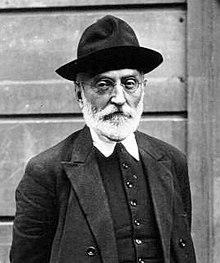
It was moments later that Miguel de Unamuno, president of the Universidad de Salamanca, rose from his chair to speak. He boldly turned to the General and the comrades and uttered the following:
“This is the temple of intelligence, and I am its high priest. You are profaning its sacred domain. You will win [venceréis], because you have enough brute force. But you will not convince [pero no convenceréis]. In order to convince it is necessary to persuade, and to persuade you will need something that you lack: reason and right in the struggle. I see it is useless to ask you to think of Spain.”
He was then ushered out of the room in order to evade harm from the falangists.
It’s crazy to think that the rooms where I take classes are the sites of all of these historical events. Each day I walk down streets which were plagued by civil war less than one hundred years ago. The restaurants that surround my neighborhood were the havens of intellectuals fighting for basic freedoms during the Franco era. Salamanca, and in particular the University, was the protector and caretaker of the spirit of the reason and progress.
Heavy stuff.
Cafe Novelty
Generally when I have a gap between my classes I like to sit outside and read. But since today is horrendously cold and windy, I am taking shelter in Cafe Novelty. This cafe is right in the Plaza Mayor…making it only five minutes (maybe less) from school. For about €3 I can get a coffee and muffin which isn’t too bad considering its optimal location.
Right now it’s siesta time. So mientras I read for class, all of the spaniards surrounding me are drinking, snacking, and laughing. Needless to say I am envious. I’ve got European Union class from 4:30-6 and despues I need to go buy a pair of shoes. For those of you shaking your head about me buying a new pair of shoes….I’d just like to say that my beige boots which I brought on this trip couldn’t withstand the new environment and their final goodbye was dramatically ripping at the side as i walked from the bus station last night. As a final “I hate you” water poured in through the sides as I struggled all the way home.
| yum yum yum |
| Sietsa time |
Monday, 11 February 2013
Saturday, 9 February 2013
De Luis Borges
Uno Aprende
Después de un tiempo, uno aprende la sutil diferencia
entre sostener una mano y encadenar un alma;
Y uno aprende que el amor no significa acostarse
y que la compañía no significa seguridad;
Y uno empieza a aprender que los besos no son contratos
y los regalos no son promesas;
Y uno empieza a aceptar sus derrotas con la cabeza alta y los ojos abiertos;
Y uno aprende a construir todos sus caminos en el hoy,
porque el terreno de mañana es demasiado incierto para planes
y los futuros tienen una forma de caerse en la mitad.
Y después de un tiempo uno aprende que si es demasiado
hasta el calorcito del sol quema.
Así que uno planta su propio jardín y decora su propia alma,
en lugar de esperar a que alguien le traiga flores.
Y uno aprende que realmente uno puede aguantar,
que uno realmente es fuerte,
que uno realmente vale,
y uno aprende y aprende…
y con cada día uno aprende.
JORGE LUIS BORGES
translation:
You Learn
After a while you learn the subtle difference
Between holding a hand and chaining a soul.
And you learn that love doesn’t mean leaning
And company doesn’t mean security.
And you begin to learn that kisses aren’t contracts
And presents aren’t promises,
And you begin to accept your defeats
With your head up and your eyes open
And you learn to build all your roads on today
Because tomorrow’s ground is too uncertain for plans
And futures have a way of falling down in mid-flight.
After a while you learn…
That even sunshine burns if you get too much.
So you plant your garden and decorate your own soul,
Instead of waiting for someone to bring you flowers.
And you learn that you really can endure…
That you really are strong
And you really do have worth…
And you learn and learn…
With every good-bye you learn
Friday, 8 February 2013
Subscribe to:
Comments (Atom)


.jpg)


.jpg)


.jpg)